Highlights

    • A golden opportunity to discover the dynamic cities of Pokhara and Kathmandu, which are popular for their rich cultures and natural wonders.
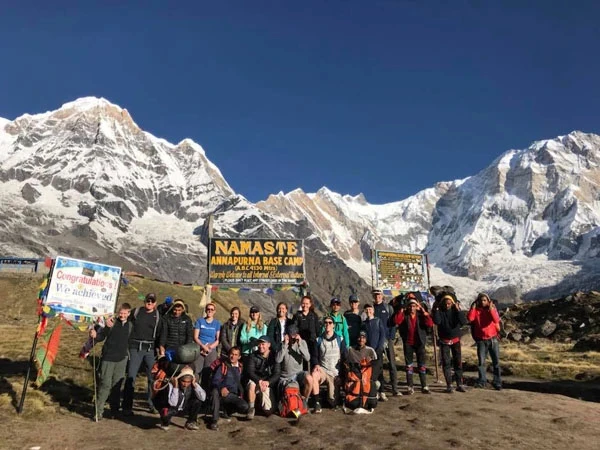
    • Reach the base of Mt. Annapurna (8,091 m), at an elevation of 4,130 m, to savor the beauty of the mountain ranges, valleys, and glaciers. 
    • Explore the distinct cultures of the Gurung and Magar communities in the Himalayas, accompanied by their warm hospitality and traditional Nepalese cuisine. 
    • A wonderful sunrise view over the Himalayas, including Dhaulagiri and Annapurna, from Ghorepani Poon Hill (3,210 m). 
    • Close vistas of snow-covered mountains, including Machhapuchhre, Annapurna I, Annapurna South, Hiunchuli, Nilgiri, and Dhaulagiri, from various vantage points. 
    • Chance to capture the wonderful scenery of a serene environment, full of blooming rhododendrons, and surrounded by cliffs and towering peaks. 
    • Experience taking a bath in a natural hot spring in Jhinu Danda, which helps you heal an aching body at the end of the trek. 
    • Spot endangered wildlife (animals and birds) and vegetation, including leopards, langur monkeys, Himalayan Tahr, blue sheep, lophophorus, eagle,  rhododendrons, oaks, and birches. 

    Annapurna Base Camp Trek starting from Pokhara and ends in Kathmandug, well-liked and moderate nature trek; through diverse landscape and culture that starts at Nayapul; an hour drive from Pokhara, which takes you to the foot [Annapurna Basecamp, 4,130m] of 10th highest mountain Mt. Annapurna, one of the most magnificent peaks in the world. The trail takes you through fascinating traditional villages of Nepal ’s ethnic communities of the Gurung, Magar, and Thakali; who will greet you very warmly if you cared to stop for a conversation. In addition, the trek continues through dense rhododendron forest with towering snowy peaks in the background; reaches the cooler Buddhist and middle hills. Annapurna Base Camp Trek is the perfect trek to view the high Himalayan; which includes Annapurna Massif (Annapurna III), Annapurna South, Hiunchuli, Fang, Mt Machhapuchhare (Fish Tail), Gangapurna, which arranges precisely in a circle with deep glacier-cover amphitheater at the center.

    Why Does the Annapurna Base Camp Trek starting from Pokhara and ends in Kathmandug Stand Out in Nepal? 

    Leaving the tourist hub Pokhara after the vibrant capital city, each step of the Annapurna Base Camp Trekking route will astonish you with unparalleled features. Starting the hike from Nayapul, a small settlement nestled about 22 kilometers southeast of Pokhara, you can make your way towards the Base Camp. While crossing the trails alongside numerous villages, you will gain knowledge that stays with you. 

    Thanks to nature, hikers savor its unspoiled beauty, showcasing awe-inspiring scenes amidst majestic Himalayan ranges and giant hills. Since Adventure Treks Nepal conducts unique Himalayan adventures in captivating trekking areas across Nepal, we offer this package to help you make your vacation memorable. To get more clarification about how the Annapurna Base Camp Trekking 14 days can be a wonderful escape, check the following: 

    Which Mountains Make the Annapurna Base Camp Trek starting from Pokhara and ends in Kathmandu Unforgettable?

    Trekking to the home of Mt. Annapurna (8,091 m), the tenth-highest mountain on our planet, is a dream of every adventurer. While enjoying jaw-dropping sights from various vantage spots, including Ghore Pani Poon Hill, you find the terrain more mindblowing as you ascend to the higher points. When you finally reach the Annapurna Base Camp at 4130 m, the highest point of the journey, take a deep breath in a cooler atmosphere for a successful climb. 

    Fluttering prayer flags welcome you there to spend a quality moment observing snow-clad mountains such as Machhapuchhre, Annapurna South, Gangapurna, Himalchuli, Tent Peak, and Hiuchuli. A night under the crystal-clear blanket of stars at the base camp will be more worthwhile than the stops at lower elevations due to both challenges and rewards. 

    What Cultural Insights Await You on the route to Annapurna Base Camp Trek starting from Pokhara and ends in Kathmandu?

    Leaving the vibrant city of Kathmandu, which represents ancient Nepal’s cultures, especially those of the local Newars, you head to the core of the Annapurna region to immerse yourself in the firsthand cultures of Nepal’s ethnic groups, such as the Magar, Gurung, and Thakali. At teahouses run by locals along the trails, they welcome you warmly with a smiley face. 

    Ancient monasteries, adorned with mani walls, prayer flags, and prayer wheels, showcase Tibetan Buddhism, kept alive for ages through generational transfer. Locals invite you to try their traditional attire, “Gunyo, Patuki, Choli and Ghalek” (women’s custom) and “Topi, Kachhad/Suruwal, Patuki, and Bhoto”(men) at the museum or homestays. 

    Can you see rare animals on the Annapurna Base Camp Trek starting from Pokhara and ends in Kathmandu?

    The 14 days Annapurna Base Camp trekking is not only about cultural immersion and physical endurance, as it takes you through the Annapurna Conservation Area, which covers districts such as Kaski, Manang, Myagdi, Lamjung, and Mustang. Enjoying rich biodiversity, ranging from lush subtropical forests to alpine meadows, catch glimpses of rare animals, including langur monkeys, Himalayan Tahr, snow leopards, and blue sheep. 

    Since the conservation Area, decorated with oaks, birches, and rhododendrons,  is also a haven for numerous butterflies and birds, nature lovers can have fun by watching them through binoculars. Whether you are a novice or a professional photographer, our guide helps you capture actions of such behaviors on your camera’s roll. 

    Who Can Join the Annapurna Base Camp Trek starting from Pokhara and ends in Kathmandu?

    Each individual has different perspectives on the difficulty level of the route to the Annapurna Base Camp. Nevertheless, this trip can accommodate younger to older family members, as the highest elevation you reach is only 4,130 m (13,550 ft.). Precautions are essential, as hikers may experience symptoms of high-altitude sickness, such as dizziness, due to the lower level of oxygen above 2500 m. 

    The schedule for the Annapurna Base Camp trek can be one of the best options for all hikers because it covers a comfortably structured trekking path in Nepal. The itinerary allows you to walk gradually at your own pace while the trekking distance per day is made appropriate, ensuring each day’s trek is not overly taxing. 

    As you will be able to adjust to the environment with the flow of your steps, Adventure Treks Nepal has not included a whole day for acclimatization. However, mental and physical preparation. If you want to embark on this 14 days Annapurna Base Camp trekking based on your preferences, adding some resting days, we can customize it. 

    Accordingly, lace your boots up for a 14-day exhilarating odyssey in the Annapurna region with our team to make it enjoyable and smooth. 

    What is the total trekking distance of the Annapurna Base Camp Trek starting from Pokhara and ends in Kathmandu? 

    While including a road ride from Kathmandu to the initial point of the route to Annapurna Base Camp and back to Kathmandu, the total travel distance is 586 kilometers. Before reaching Nayapul to begin the hike, you will drive 200 km to Pokhara city within 6-7 hours. Enjoy each step on the trekking route with your fellow trekkers, covering approximately 89 kilometers. Due to easy access to the origin, the trek is not as long as the longer version, the Annapurna Circuit Trek. 

    Nevertheless, unpredictable weather and other factors that impact the trekking may sometimes extend or minimize the Annapurna Base Camp trekking distance and duration. As the Annapurna trails are well-marked, the average hiking distance is almost 10 kilometers. For more clarity, we have listed below the hiking distance and duration for each day.

    • Nayapul to Ulleri:                      10.8 kilometers/6-7 hours 
    • Ulleri to Ghorepani:                  10.3 kilometers/4-5 hours 
    • Ghorepani to Chule:                 13.9 kilometers/6-7 hours 
    • Chule to Chhomrong:               11 kilometers/5 hours
    • Chhomrong to Deurali:             12 kilometers/6-7 hours 
    • Deurali to Annapurna Base Camp:8 kilometers/6 hours 
    • Annapurna Base Camp to Bamboo/Sinuwaa: 13 kilometers/8-9 hours
    • Bamboo/Sinwa to Jhinu Danda: 8 kilometers/5-6 hours 
    • Jhinu Danda to Samrung:          1.5 to 2 kilometers/1 hour-1.5 hours 

    How much does the Annapurna Base Camp Trek starting from Pokhara and ends in Kathmandu Cost? 

    Various factors, including the chosen itinerary, route, season, accommodation, food, facilities, a guide, porter service, hiking distance, and duration of the trek, influence the Annapurna Base Camp Trekking Cost. Since a hiker can easily reach the starting point by a 4WD, avoiding a domestic flight, the total expense might be lower. 

    Except for international airfare, travel insurance, Nepal entry visa, extra food and dessert, meals in cities, and tips for a porter and driver, sleeping bags, and a down jacket, Adventure Treks Nepal’s cost for the 14-day ABC trek covers others, including trekking permits and other logistics. The cost of the trek may be higher during the peak seasons (spring and autumn) than off-seasons, as demand for guides, porters, food, and teahouses significantly increases.

     As a result, prebooking is necessary for these months to ensure your logistics. Respect locals’ hard work when you find the prices slightly higher than the normal cost in some rural areas. Check the inclusions below in the Cost Details section for this Annapurna Base Camp Trekking package to avoid unexpected expenses along the route and plan your trip strategically. 

    Smooth itinerary: How Does a Day Unfold on the Annapurna Base Camp Trail?

    The package for a 14-day Annapurna trekking trip is activated when our representative from Adventure Treks Nepal picks you up from Tribhuvan International Airport to transfer you to the hotel for an overnight stay. The next day, a thrilling road ride on the Prithvi Highway, crossing Dhading, Mugling, Dumre, Damauli, and Khairenitar, takes you to the mesmerizing city of Pokhara. Enjoy the evening at Lakeside with the views of Machhapuchhre on Phewa Lake and taste various food items at restaurants before heading to the higher terrain to adjust to the common teahouses and food.

    After a drive to Nayapul, traverse settlements such as Birethanti and Tikhedhunga, as well as suspension bridges, to reach Ulleri. As each day begins with a hearty breakfast, make your way towards Ghorepani (2020 m), crossing settlements like Nangethati and Banthati alongside dense rhododendron forests. By gaining 400 m elevation, go on a side hike to Poon Hill (3210 m), a picturesque viewpoint for the scene of majestic peaks and sunrises over them. 

    Clicking the photographs in the background of golden-hued mountains and the first rays of sunlight illuminating peaks, the 14 days Annapurna Base Camp Trekking itinerary instructs you to get back to the teahouse for breakfast before leaving Ghorepani  for Chule. Ascending trails take you to Thabala Hill in the first phase of the hike, and the downhill paths begin from here to reach Deurali. After climbing up to Tadapani, take the left trail for Chule for overnight stays. On the 6th day, leaving Chule, you will pass by villages such as Chhomrong and Deurali before climbing up to the Annapurna Base Camp, the most awaited destination of the trek. 

    Although the Annapurna Base Camp trail is relatively easier than the Everst Base Camp, standing at the Annapurna’s foothills will give you equally awe-inspiring scenery. After spending a night at the base camp, you will get back to Bamboo, retracing the same trail that you used to reach the base of Mt. Annapurna. However, the journey will be more comfortable as the trails are mostly downhill. If you have enough time after reaching Bamboo, proceed ahead to Sinuwa for an overnight stay. 

    When you are almost near the conclusion of official trekking in the Annapurna region, the trail introduces you to a marvelous spot called Jhinu Danda, which is popular for its natural hot springs, soothing atmosphere, and natural charm. Taking baths in hot springs heals the pains in your body and legs caused by prolonged walks through paths with steep ascents and descents. After a hearty breakfast, make your way towards Samrung, descending to the river, and cross a long suspension bridge before climbing up for a road ride. 

    From here, an electrifying drive alongside the Modi Khola River will take you to Pokhara within 3 to 4 hours. During the leisure period in the evening, you can either take a rest or explore around the city for more knowledge. Depending on the Annapurna Base Camp Trekking itinerary, drive back to Kathmandu on the 12th day of the trek, following the Trishuli River alongside the traditional settlements, dense forests, and vibrant markets. The next day, you have a whole leisure day; you can either visit the historical places of the Kathmandu Valley and nearby tourist spots or take rest to heal pains. 

    Finally, the trip is over on the 14th day when our representative from Adventure Treks Nepal will drop you off at the airport for your flight to get back to your homeland. This itinerary of 14 days allows you to continue the hike without much more physical strain. Accordingly, it can be an iconic schedule for you if you want to delve into the Annapurna’s serenity. However, the itinerary is customizable, and you can either shorten or extend the trip based on your vacation or choice. Nevertheless, for those trekkers with a few-days vacation and prefer more budget-friendly ABC trek, we have a 8-day Annapurna Base Camp Trekking from Pokhara. 

    Why do the Annapurna Base Camp Trek starting from Pokhara and ends in Kathmandu with us? 

    Amidst numerous trekking and travel companies in Nepal, Adventure Treks Nepal has become one of the top-rated ones, boasting over 30 years of experience in organizing Annapurna Base Camp trekking. Experienced members of a team, who are well-known to local landmarks and communities, will help you accomplish the trip in the Annapurna region stress-free. A licensed guide with sufficient training handles all the situations, including altitude-sickness-related issues. 

    Choosing us means making your Himalayan journey incredible at an affordable cost. There is no complex booking process to join our 14-day Annapurna Base Camp Trekking. You can contact us or click the button "Book this trip" on the right of the web page and proceed with the process as instructed. Bookings are open. Contact us at:  [email protected]   without hesitation for more inquiries, as we will respond instantly. 


    Itinerary
    Trip Plan
    Expand allCollapse all

    Once you arrive at the Pokhara  International Airport in Pokhara (City of Natural beauty) you will be transferred to the hotel by a representative (Trekking Guide) of Adventure Treks Nepal who will be waiting for your arrival outside the airport. We transfer to the Hotel.

    • Max Altitude: 970 Meters
    • Meals: Null
    • Accommodation: Hotel

    After your breakfast at the hotel in Pokhara we begin our drive to Nayapul which is approximately 40 k.m. from Pokhara. The drive will take around 1 hour 30 min after which we will begin our trek. The first part of the trail takes us to Birethati where we will check in our ACAP permit and TIMS. We then cross the river at Birethati and head left along the gentle slope to Tikhedhunga where we cross the Bhurungdi Khola River on two suspension bridges. After crossing the river we will start the steep climb to Ulleri where we will be spending the night.

    After breakfast we continue our trek towards Ghorepani through the settlements of Banthati and Nangethati. We also pass a spring inside the forest after Banthati. Crossing the spring by a bridge we continue towards our destination. Occasional views of the peaks give way to a narrower valley, passing through Rhododendron forest then eventually reaching the village of Ghorepani where we spend a night.

    Your guide will check the weather forecast and let you know the sunrise time. We will hike up to Poonhill early in the morning and return back to the tea house for breakfast. The sunrise from Ghorepani is said to be one of the best sunrise as the Annapurna , Dhaulagiri and Manaslu Himalayan Range which includes Nilgiri, Tukuche Peak, Annapurna South, Dhaulagiri, Annapurna I, Barahi Shikhar, Machhapuchhre offer breathtaking views.

    After breakfast we continue trekking towards Chuile. The first part of the trek is an ascent to Thabala Hill from where we will observe magnificent views of the Himalayas. We will then descend down to Deurali where we pass a few teahouses and continue towards Banthanti where we will have our lunch. The trail then descends to a river from where we again climb up to Tadapani from where we take a left towards Chule.

    The day begins on a sheer path inside the Rhododendron forests after your breakfast and onto the terraced fields which seems absolutely stunning. We then climb unwaveringly passing exalted waterfalls and cross a suspension bridge. The trail ahead is a fixture of ups and downs finally reaching Chhomrong, our final destination for the day. It is a beautiful village located on the lap of the giant Annapurna massif. 

    Unable to locate what you're seeking?

    Reach out to our travel experts.

    Cost Details
    Included
    • Arrival and Departure Transport. (International and domestic)
    • Accommodation in Kathmandu (Twin Sharing) with breakfast.
    • Accommodation in Pokhara with (Twin Sharing) breakfast.
    • Trekking Duffel Bag. (Using for Trekking).
    • Breakfast, Lunch & Dinner during the Trekking. (Food as mentioned)
    • Accommodation in a teahouse during the trekking. (Above Chhomrong is the dormitory).
    • Pokhara-Kathmandu flight..
    • Pokhara Nayapul Transport.
    • Syaulibazar Pokhara Transport.
    • Trekking Porter with Insurance. (We Provide 01 Porter for 02 Pax).
    • Trekking Guide with insurance.
    • Trekking guide and porter's food and accommodation, wages, etc.
    • First Aid kit.
    • Annapurna Base Camp Trekking Region map.
    • Price based on 2 pax min.
    • Annapurna Conservation Area Project (ACAP) entry permit fee.
    • Trekker’s Information Management system (TIMS).
    • All Government taxes.
    • Office service charge.
    Excluded
    • International Airfare.
    • Your travel insurance of any kind
    • Nepal entry Visa fee (US$ 30 for 15 days and US$ 50 for 30 days; you should get visa upon your arrival)
    • Drinkking Water, Extra Tea Coffee, Dessert, Juice, WIFI, Heater charge, Hot Shower etc. during the Trekking and main meals in cities.
    • Tips for Guide, Porter and driver.
    • Sleeping Bags (-20C), Down Jacket.
    Essential Information

    What is the Best Season to trek to Annapurna Base Camp Trek starting from Pokhara and ends in Kathmandu ?

    Timing to trek to the Himalayan terrain in Nepal is necessary. However, most places are doable year-round, including the Annapurna Base Camp Trekking, to avoid unexpected circumstances on the trails. Generally, spring (March to May) and autumn (September to November) are the best times to trek to any destination due to unique features, pleasant weather, moderate temperature, and suitability for walking. 

    While off-seasons present more risks due to floods, landslides, and avalanches while walking, these trekking months of blooming flowers and crystal-clear skies also prevent the potential hazards of getting injured. Although the hike only takes you to 4,130 m, the Annapurna Base Camp trekking in the winter becomes quite challenging because of the extreme cold. The monsoon brings heavy rainfall to most places in Nepal, blocking major trekking trails. 

    Accordingly, we recommend avoiding the Annapurna Trek and other trips during the period of winter and monsoon to not ruin your entire journey. 

    Why are trekking permits required for the Annapurna Base Camp Trek starting from Pokhara and ends in Kathmandu ? 

    Completing the essential travel documents to trek to Annapurna Base Camp ensures your security, along with safeguarding against legal liabilities, since permits are compulsory, like other trips in Nepal. Nevertheless, these documents serve not only legal purposes but also ensure timely rescue in case of emergencies, as your detailed information and itinerary are kept on record with the administration. A TIMS (Trekkers Information Management System) Card and an ACAP (Annapurna Conservation Area Permit) are necessary permits for this 14-day Annapurna trekking, which can be obtained either from Kathmandu Valley or the city of Pokhara. 

    However, our team will proceed with this paperwork before you arrive on your behalf, letting you focus on your preparation for the trip. At various checkpoints, such as Birethati, you have to verify your permits to enter the region to explore. In the absence of these documents, the government takes necessary legal actions, adhering to Nepal’s trekking rules. Therefore, select a reliable travel company that does genuine work and helps you in completing your dream journey. 

    The collected funds for permits are used to maintain trekking trails and support conservation efforts, which contribute to the concept of sustainable treks. The major pros of regulating permits are also employing locals and uplifting their economic status. For clarity, we have also mentioned the cost for permits below: 

    Annapurna Conservation Area Permit  (ACAP)

    • NPR 1000 per person for SAARC nationals
    • NPR 3,000 per person for other citizens
    • Children below 10 years do not require an ACAP permit

    TIMS Trekkers Permit

    • NPR 2,000 per person for independent trekkers
    • NPR 2,000 per person for organized treks through an agency
    • NPR 600 per person for SAARC nationals

    Does travel insurance protect you during the Annapurna Base Camp Trek starting from Pokhara and ends in Kathmandu ?

    Generally, the importance of travel insurance arises on the Annapurna Base Camp Trekking since it takes you above 4000 m, increasing the potential risks of acute high sickness and getting an injury on challenging, rough terrain. The unpredictable weather of the Annapurna region may present unforeseen challenges, sometimes even leading to worst-case scenarios. Accordingly, we recommend you all prepare yourselves to face any circumstances, although you have the travel insurance, which also covers helicopter evacuation above 3000 m during emergencies. 

    Since the travel insurance covers the expenses for medical treatment and other unforeseen cases, including trip cancellation, flight delay or cancellation, and personal belongings damage, loss, or theft, the insurance will not let you bear the entire financial burden on your own. Obtaining travel insurance before embarking on a high-altitude trip like the Annapurna Base Camp is a wise way to safeguard yourself against unexpected challenges, although the possibility of things going wrong is relatively low. If you are planning a cost-effective trek, ensure that you have the right travel insurance, which will save you money and allow you to get rescued on time if needed. 

    Note: Before beginning a trek, every hiker must provide all individual documents for travel insurance. Without the insurance, we may cancel your trip, and no amount will be refunded.

    Where to stay during the Annapurna Base Camp Trek starting from Pokhara and ends in Kathmandu ?

    Shelters for safety are necessary during trekking in the Himalayan landscapes, including the Annapurna region. Since transportation access is effortless to most areas alongside the ABC routes, you will find comfortable teahouses, guest houses, and mountain lodges based on your choices, which provide cozy rooms with common furniture and amenities. 

    Although you will enjoy five-star hotels while in the city areas of Pokhara and Kathmandu, you must adjust to simple accommodations in the remote, higher settlements during the Annapurna Base Camp trekking, where you might not get advanced facilities, such as hot showers and internet, but enjoy a family-friendly environment. Locals’ pleasant hospitality and fresh and nutritious food, along with quality interaction, will make overnight stays in simple teahouses worthwhile. 

    A nutritious meal also plays a vital role in keeping yourself healthy as well as strong enough for prolonged walking. Teahouses alongside the Annapurna Base Camp trails serve, providing you with hygienic and power-provider foods. You will mostly get to have “Dal and Bhat” during this 14-day trek on trails, which includes steamed rice, seasonal green vegetables, lentil soup, and pickle of tomato, coriander, and mint. 

    Some restaurants in large settlements also offer a wide range of food items, including Tibetan (Tsampa, thukpa, and Tibetan bread) and Western (pasta, fried rice, omelets, sandwiches, burgers, and French fries). If you eat more food than mentioned on the company’s scheduled menu, you have to pay out of your pocket. You may get beverages and desserts at teahouses, which add additional charges to the Annapurna Base Camp Trekking cost. 

    How Difficult is the  Annapurna Base Camp Trek starting from Pokhara and ends in Kathmandu ?

    While talking about the Annapurna Base Camp Trekking difficulty, it is one of the best moderate-level journeys in the Annapurna region. From a child to an adult, anyone can reach the foothills of Mt. Annapurna with the right gear and preparation. Nevertheless, hikers should be prepared to tackle unpredictable weather and high-altitude-related challenges above 2,500 m. Traversing some landslide-prone areas, glacial moraines, and steep ascents/descents on a 14-day trip may create some difficulties. 

    Before you reach the Annapurna Base Camp, Deurali (3200 m) is a high-altitude settlement, which may have a few teahouses with minimal facilities but provides you with comfortable and secure shelters. Due to thin air and freezing temperatures in higher terrain, a novice or a seasoned hiker may face difficult circumstances. However, our itinerary is tailored for every individual, regardless of age and fitness level, to avoid physical and mental fatigue. 

    Symptoms of altitude sickness: Difficult sleeping, Headache, shortness of breath, vomiting, loss of appetite, dizziness, confusion, swelling of hands, feet, or face, and fatigue

    How can you prepare for the Annapurna Base Camp Trek starting from Pokhara and ends in Kathmandu ? 

    Guided and planned trekking always goes more smoothly than solo trekking, as an unmanaged one can bring unwanted hassles and risks. However, the hiking rule does not allow any self-guided trips in Nepal, considering trekkers’ safety. Although a guide will be with you, you should prepare mentally and physically to tackle some demanding sections of the Annapurna trails, adjust to high-altitude rough terrain, and balance the stamina required for long days of walking. 

     Engage in common cardiovascular exercises such as jogging, running, swimming, rowing, and walking, along with hiking to nearby hills or trails with an elevation of more than 2000 m to boost physical readiness and ensure smoother performance in high-altitude mountainous terrains. We recommend practicing meditation and yoga a month before the trip, which helps in navigating the demanding trails of the Annapurna region during the 14-day Annapurna Base Camp Trekking and fosters mental resilience and emotional stability, along with physical strength. 

    Is a Guide or Porter Necessary for the Annapurna Base Camp Trek starting from Pokhara and ends in Kathmandu?

    To obtain trekking permits for any hiking destination in Nepal, hiring a guide is mandatory, which helps you navigate trails safely and immerse yourself in the rich cultural treasures, traditions, and lifestyles of ethnic groups such as the Gurung, Magar, and Thakali. Our experienced Nepal trekking guides from Adventure Treks Nepal are fluent in English and familiar with local dialects. Accordingly, you will know the history of places, ancient gompas and monasteries, and local traditions as they can share the hidden stories and insights they learn from various communities.

    Although you have a map, only an experienced guide knows alternative routes if the main trail becomes inaccessible due to construction or natural disasters such as floods. landslides and avalanches during the trek. Hiring both a guide and a porter makes your adventure unforgettable because the guide guarantees your security and also helps you during jungle activities in the Chitwan National Park, while the local porter lets you walk freely by carrying your heavy bags of trekking gear and other essentials for the hike. 

    What to pack for the 14 days Annapurna Base Camp Trek starting from Pokhara and ends in Kathmandu? 

     Strategic packing also falls under the aspect of the trek, for which you should plan carefully to avoid unnecessary items that increase only the weight of your backpack. Since the right hiking essentials guarantee your security while walking on mountainous terrains, carefully pack to ensure the completion of the trip without more challenges. To make it easier for you to pack, we have mentioned below the Annapurna Base Camp Trekking checklist for Annapurna Base Camp Trekking as follows: 

    Clothing

    • Moisture-wicking base layers (Merino wool t-shirts or long-sleeve tops, synthetic polyester or nylon thermal tops, lightweight compression tops, and leggings)
    • Insulating mid-layers (Fleece jackets or pullovers, down vests or jackets, synthetic insulated jackets)
    • Waterproof outer layers (Waterproof hardshell jackets with breathable membranes (e.g., Gore-Tex), Waterproof pants or rain pants, Windproof rain shells)

    Footwear

    • Trekking boot with sturdy grip 
    • Socks (both thick woolen and thinner) 
    • Slippers/lightweight sandals
    • Gaiters 

    Trekking gear 

    • Trekking poles
    • Sleeping bag 
    • Day backpack 
    • multi-tool or pocket knife, 
    • Rain cover for backpack,

    Health and Personal items 

    • Reusable water bottle
    • Water purification tablet
    • Insect repellent 
    • Sunscreen, Hats, and UV glasses
    • First Aid Kit with medication related to acute mountain sickness, blisters, bandages, personal medicines, and painkillers. 
    • Biodegradable soap, wet wipes, hand sanitizer, and quick-dry towels

    Travel documents and permits

    • Valid passport
    • Passport-size photos
    • Travel Insurance
    • Trekking permits (A TIM’s card, ACAP, and Chitwan National Park Entry Permit) 

    Others 

    • Headlamp with extra batteries
    • Cameras and Binoculars
    • Charger, power bank 
    • Journal, pen, and games